The Snowball Effect
See how a starting balance and regular monthly contributions grow over time as interest compounds on itself.
Estimate only. Assumes contributions are made monthly and interest compounds at the selected frequency; actual account terms may differ.
Simply enter your initial investment, interest rate, compounding frequency, contribution amount, and investment period to instantly calculate your future balance, total interest earned, and overall investment growth.
Whether you’re planning for retirement, building long-term wealth, saving for education, or reaching financial goals, this calculator provides fast and accurate results to help you make smarter financial decisions.

A Compound Interest Calculator helps you estimate how your money can grow when you earn interest on both your original principal and the interest that has already accumulated. Whether you are saving for retirement, building an emergency fund, investing for the long term, orcomparing savings accounts, a compound interest calculator can show how your balance may change over time.
You can use it as an investment calculator, interest calculator, savings calculator, or financial calculator by entering your starting amount, regular contributions, interest rate, compounding frequency, and investment period. Unlike simple interest, compound interest allows previous interest earnings to become part of the balance and potentially generate additional interest.
What is compound interest? In simple terms, it is interest earned on your initial deposit or investment plus the interest that has accumulated over time. This is why compounding can have a powerful effect over long periods. If you leave your earnings invested instead of withdrawing them, the account balance can gradually grow at an increasing rate.
This process is sometimes described as compounding interest, compounded interest, or compound growth. The longer your money remains invested and the more frequently interest compounds, the greater the potential effect. Your actual results, however, depend on the interest rate, contributions, fees, taxes, and the type of account or investment.
If you want to compare your potential investment returns, try our ROI Calculator to measure profitability.
If you’re wondering how does compound interest work, imagine depositing $5,000 into an account that earns interest. During the first period, interest is calculated on the original $5,000. In the next period, the calculation may include both the original deposit and the interest previously earned. Over many years, those additional earnings can themselves generate interest. This is the key difference between compound interest and simple interest. With simple interest, interest is generally calculated only on the original principal. With compound interest, interest can be added back to the balance and then earn additional interest. This is why people often refer to compounding as earning interest on interest.
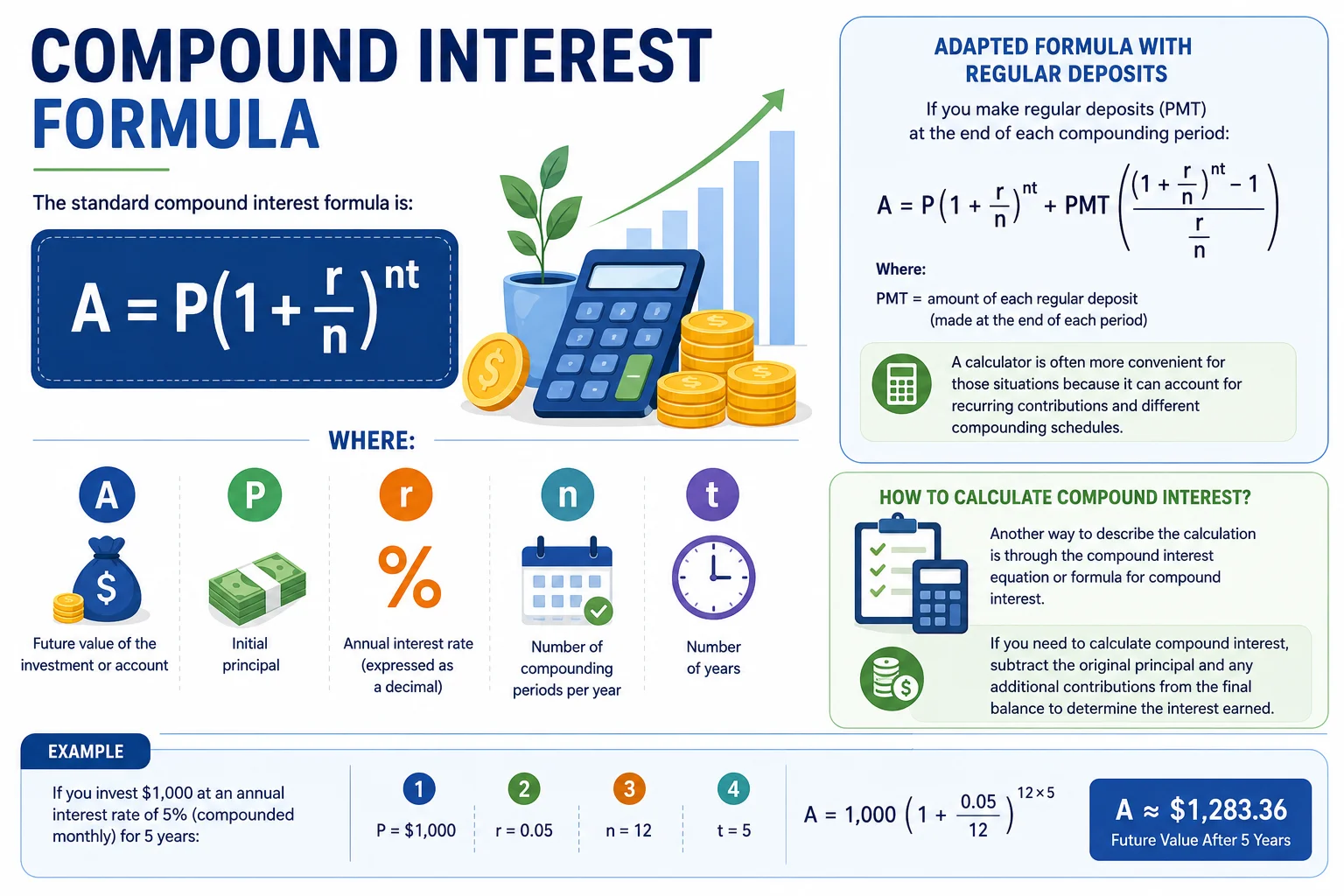
The standard compound interest formula is:
A = P(1 + r/n)^(nt)
Where:
A = future value of the investment or account
P = initial principal
r = annual interest rate expressed as a decimal• n = number of compounding periods per year
t = number of years
The formula can also be adapted when you make regular deposits. A calculator is often more convenient for those situations because it can account for recurring contributions and different compounding schedules. Another way to describe the calculation is through the compound interest equation or formula for compound interest. If you need to calculate compound interest, subtract the original principal and any additional contributions from the final balance to determine the interest earned.
If you want to know how to calculate compound interest, first identify the principal, annual interest rate, compounding frequency, and investment period. Then apply the compound interest formula or enter those values into an online compound interest calculator.
For example, suppose you invest $10,000 at an annual rate of 5%, compounded annually, and
leave it untouched for 10 years. The formula estimates the future balance by applying the 5% rate repeatedly to the growing account balance.
The result demonstrates why time can be just as
important as the initial investment when building wealth.
A figure compound interest calculator, compound interest calc, or compound calculator can perform this calculation instantly. You can also use a financial calculator online when you want to compare different scenarios.
Explore the Mortgage Calculator to calculate monthly payments and total interest on a home loan.
A daily compound interest calculator is useful when interest is compounded every day rather than monthly, quarterly, or annually. With compound interest calculated daily, the number of compounding periods per year is typically 365, although the exact method depends on the
financial institution and account terms. Daily compounding does not automatically mean an account will produce dramatically higher
returns than monthly compounding.
The difference depends on the interest rate and account balance. When comparing financial products, look at the APY (Annual Percentage Yield) when available because it incorporates the effect of compounding. You can use a compound interest calculator for daily compounding to compare daily, monthly, and annual schedules and see how the frequency affects the projected balance.
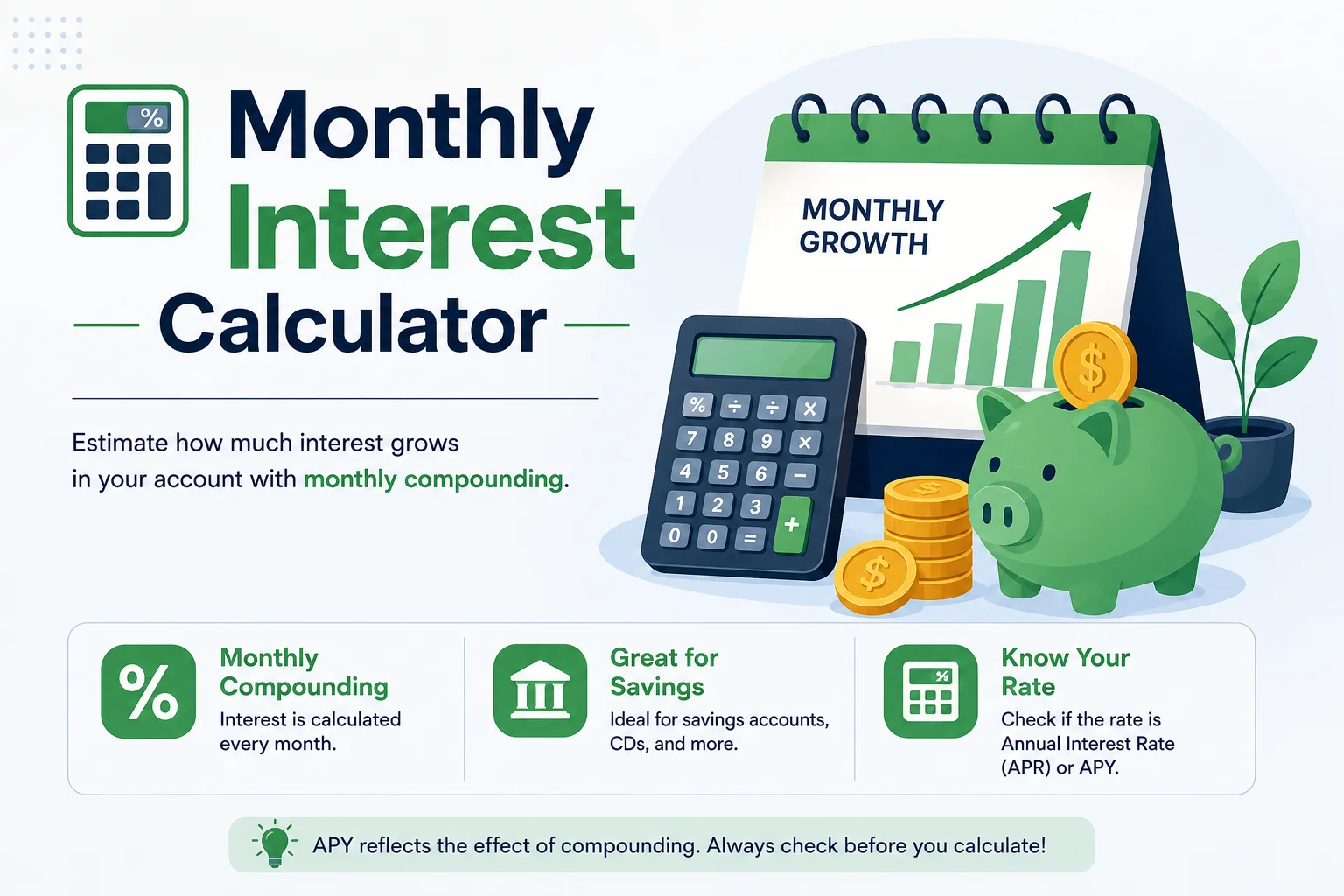
A monthly interest calculator can estimate how much interest accumulates when an account compounds monthly. This can be particularly helpful for savings accounts, certificates of deposit, and other interest-bearing accounts. When using an interest calculator savings tool, check whether the stated rate is an annual interest rate or APY. These terms are not interchangeable. The compounding schedule and the way the financial institution quotes the rate can affect your final calculation.
A simple interest calculator uses a different approach from a compound interest calculator.
With simple interest, the basic formula is:
I = P × r × t
where the interest is based on the original principal.
Compound interest, on the other hand, adds previously earned interest to the balance. Over short periods the difference may be relatively small, but over several decades it can become substantial. If you’re looking for a figure simple interest calculator, comparing both calculations can help you understand the effect of compounding on long term savings and investments.
An investment growth calculator can help you visualize how an investment may grow through compounding and regular contributions. You can use an investment calculator over time to compare a one-time deposit with a strategy that includes monthly or annual contributions.
For example, someone investing $500 every month may accumulate significantly more over
several decades than someone who makes only an initial deposit. The exact outcome depends on the assumed rate of return and investment performance, but the calculation demonstrates the potential importance of consistent investing.
You can also use the CD Calculator to estimate earnings from a Certificate of Deposit.
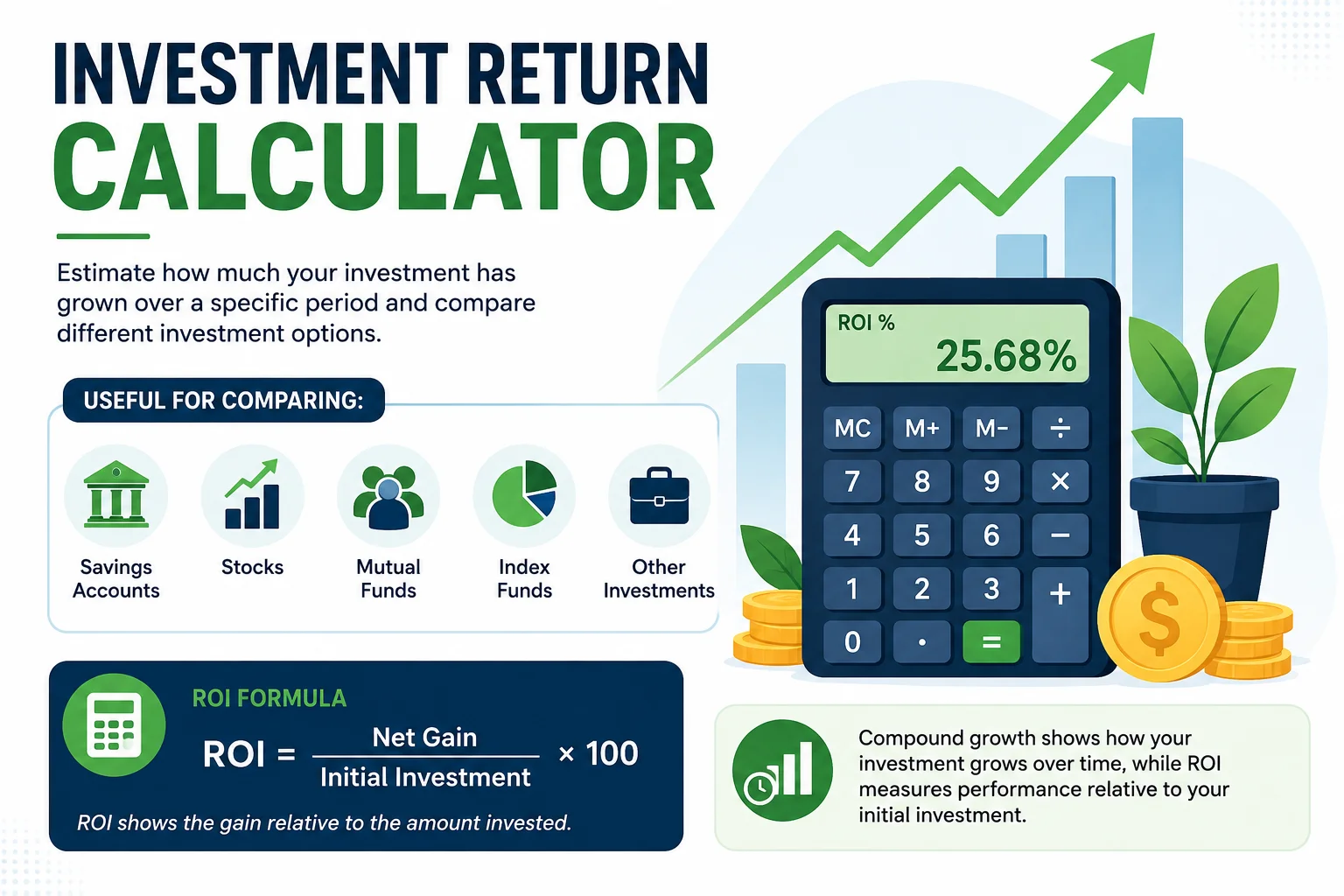
An investment return calculator helps estimate how much an investment has gained over a specific period. It can be useful for comparing savings accounts, stocks, mutual funds, index funds, and other investments. A return on investment calculator generally focuses on the gain relative to the amount invested, while a compound growth calculator emphasizes how an account or investment cangrow over time. Both can be useful, but they answer slightly different questions.If you want to understand how to calculate return on investment, the basic ROI formula is:
ROI = (Net Gain ÷ Initial Investment) × 100
ROI and compound growth should not be confused because they measure different aspects of
investment performance.
A savings calculator can estimate how much your savings account could grow when you make regular deposits and earn interest. This makes it useful for setting goals such as building anemergency fund or saving for a large purchase. A savings interest calculator can show the estimated interest earned, while a savings account interest calculator can help compare different interest rates and contribution schedules. If you’re considering a high-yield account, you can also use a high yield savings calculator or HYSA
calculator to estimate potential growth.
A high yield savings account calculator can help estimate the potential growth of money held in a high yield savings account. A HYSA calculator is especially useful when comparing different APYs, initial deposits, and monthly contributions.
For example, you can compare how much $10,000 might grow at 3%, 4%, or 5% APY over
several years. Keep in mind that savings account rates can change, so a calculator projection is
an estimate rather than a guarantee of future earnings.
A compound interest account can refer to a savings or investment account where earnings are
added to the balance and can subsequently generate additional earnings. Examples may include
certain savings accounts, money market accounts, certificates of deposit, and investment
accounts.
When comparing accounts, don’t look only at the advertised interest rate. Consider the APY,
fees, minimum balance requirements, withdrawal rules, taxes, and whether the rate is fixed or
variable.
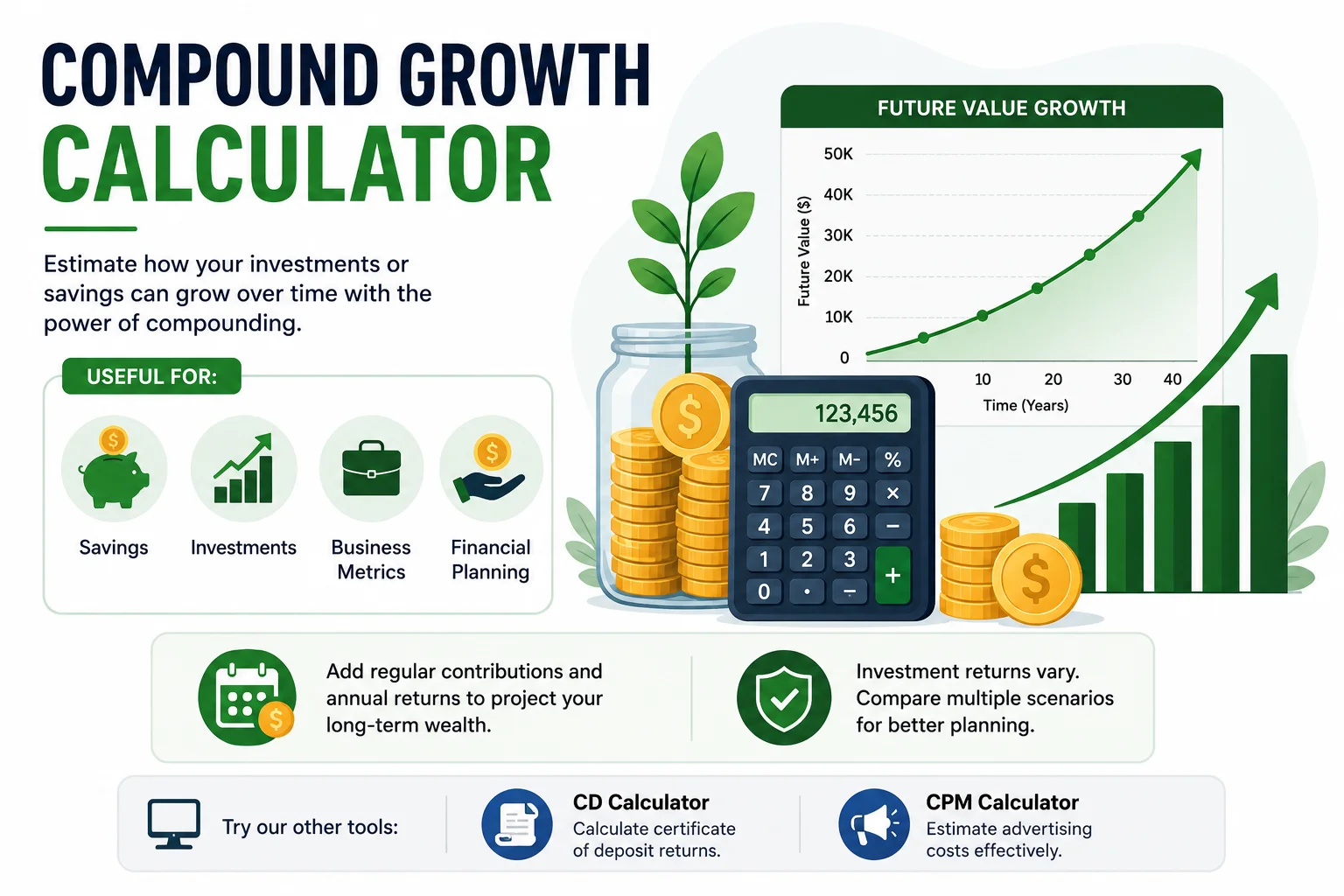
A compound growth calculator is useful for estimating how an asset or investment may increase in value over time. The compound growth formula can be applied to savings, investments, business metrics, and other situations where growth builds upon previous growth. For financial planning, you can combine an assumed annual return with regular contributions to estimate potential long-term wealth. Because investment returns are uncertain, use multiple scenarios rather than relying on one projected rate. Try our CD Calculator for certificate of deposit returns, CPM Calculator for advertising costs.
A compound annual growth rate calculator calculates CAGR, which represents the average annual rate at which an investment would have grown over a specified period if it had grown at a consistent compounded rate.
The basic CAGR formula is:
CAGR = (Ending Value ÷ Beginning Value)^(1 ÷ Years) − 1
CAGR is commonly used to compare investment growth, business revenue, or other values across different time periods. Unlike an actual year-by-year return series, CAGR smooths the growth into a single annualized rate.
A mutual fund calculator can estimate the potential growth of an investment based on an assumed rate of return and contribution schedule. An index fund calculator can be used in a similar way for investments designed to track a market index. When using either tool, remember that investment returns are not guaranteed. Fees and expenses can also reduce the amount that ultimately compounds over time.
The ROI Calculator helps estimate potential returns.
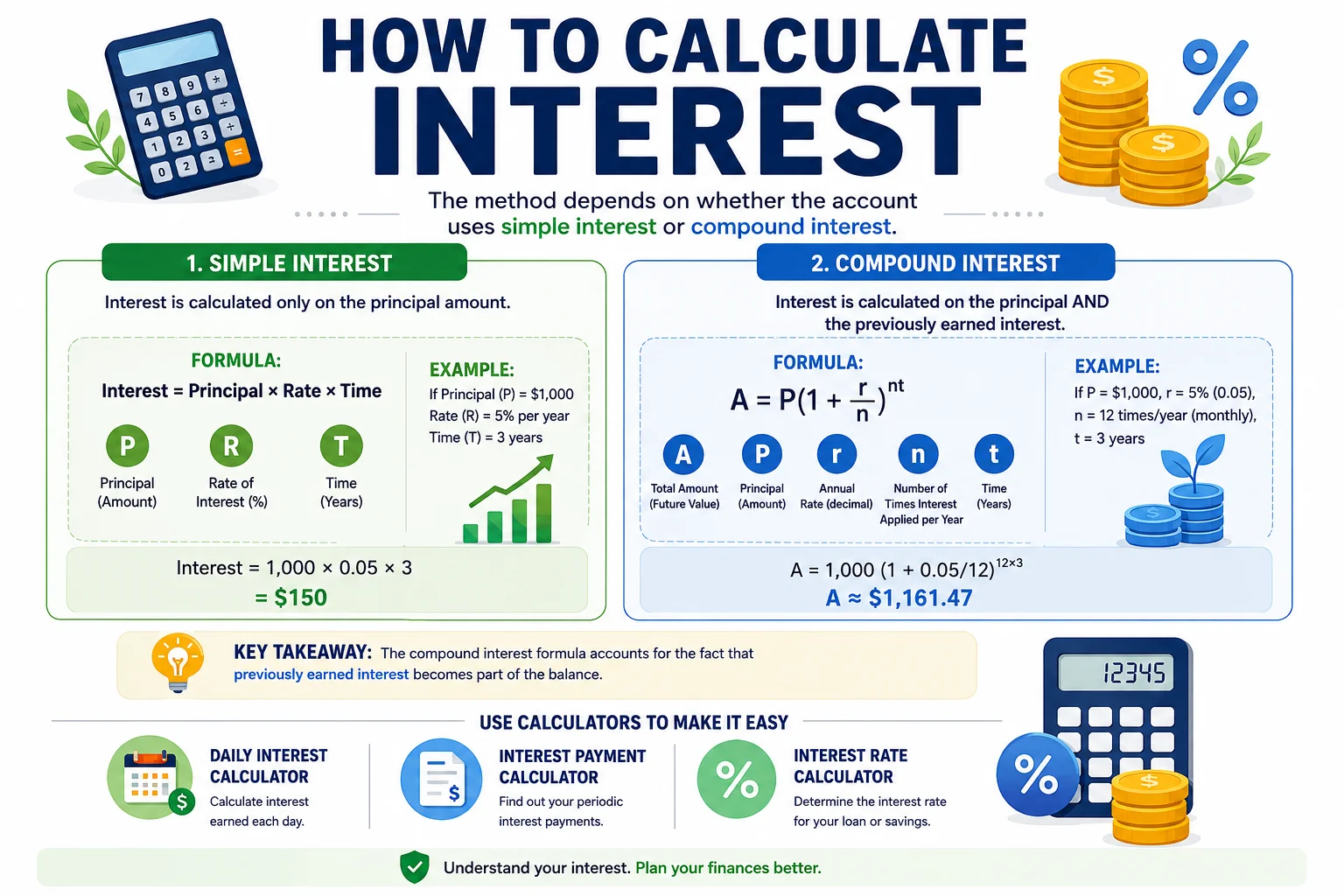
If you’re asking how to calculate interest, the method depends on whether the account uses simple interest or compound interest.
For simple interest:
Interest = Principal × Rate × Time
For compound interest:
A = P(1 + r/n)^(nt)
The second formula accounts for the fact that previously earned interest becomes part of the balance. A daily interest calculator, interest payment calculator, or interest rate calculator can simplify these calculations.