
Financial Planning
Estimate what a certificate of deposit will be worth at maturity, based on your deposit, rate, term, and compounding frequency.
CD rates are not the same everywhere. Every bank and credit union sets its own rates, and the rate you get also depends on the term you choose a 6-month CD will rarely pay the same as a 1-year or 2-year CD. That is why comparing offers side by side matters before you lock your money in.
When you compare, look beyond the headline rate. The APY (Annual Percentage Yield) shows what you will actually earn over a year, while the minimum deposit, early withdrawal penalty and maturity terms decide whether a CD truly fits your plans.
Shorter terms, such as 6 months, suit savers who do not want to commit their money for long. A 12-month CD can be a better fit if you can comfortably leave the money untouched for a year. In both cases, the best rates usually go to savers who check more than one institution instead of taking the first offer they see.
A good CD rate is simply one that pays you a fair return for a period you are comfortable with. Once you have shortlisted a few banks, use the CD calculator above to see exactly how much interest each offer could earn you by maturity
CD Growth Calculator provides information on how a certain deposit may grow in a CD within a specified period. In most cases, this process will depend on the initial balance, APY, duration of the term, and how interest is compounded. A fixed interest rate can also make it easier to estimate potential CD earnings over the selected term.
For example, let’s say that you invest $10,000 in a one-year CD that earns 4.00% APY. If you hold the money for the whole term at the APY, you will have earned about $400, and your balance at maturity will be about $10,400. This estimated amount represents the CD maturity value at the end of the term.
This tool becomes handy when you are shopping for various CD interest rates. You may come across one institution providing six-month CD at one interest rate, while the other is giving 12-month CD at another rate. This is when you plug in these numbers and determine the dollar benefit from the comparison and not by the rates only.
The amount of the deposit may also affect this comparison. While a small change in the APY does not make much difference on a small amount, it starts being noticeable as the amount of deposit grows.
For advertising related calculations, the CPM Calculator can help you understand cost per thousand impressions, while our Mortgage Calculator is useful for estimating monthly home loan payments and overall mortgage costs.
A CD interest calculator addresses the simple question about how much your money will earn at the end of the term of the CD? The CD interest calculation can give you a clearer idea of the potential CD returns before the account reaches maturity.
In order to find out an approximate return on investment, you will have to provide the amount of deposit, annual interest or APY, and the CD term. Sometimes, you might also be required to indicate the frequency of compounding. You can use these details to calculate CD interest based on the terms offered by the financial institution.
For example, suppose that you are comparing two hypothetical CDs based on a $10,000 deposit:
| CD | APY | Term | Interest |
|---|---|---|---|
| CD A | 3.50% | 12 months | $350 |
| CD B | 4.00% | 12 months | $400 |
The gap between the two CDs does not seem big when you just compare their rates; however, CD B will yield you $50 more.
And here comes the role of a CD rate calculator. With its help, you can convert the offered rate to an approximate return on investment, which will help you determine which CD offer is better.
Besides comparing annual interest rates, keep in mind that APY should also be taken into account while making decisions. The thing is that APY is a more convenient measure than interest because of the compound interest factor. Looking at the CD APY can make it easier to compare the potential return of different accounts.
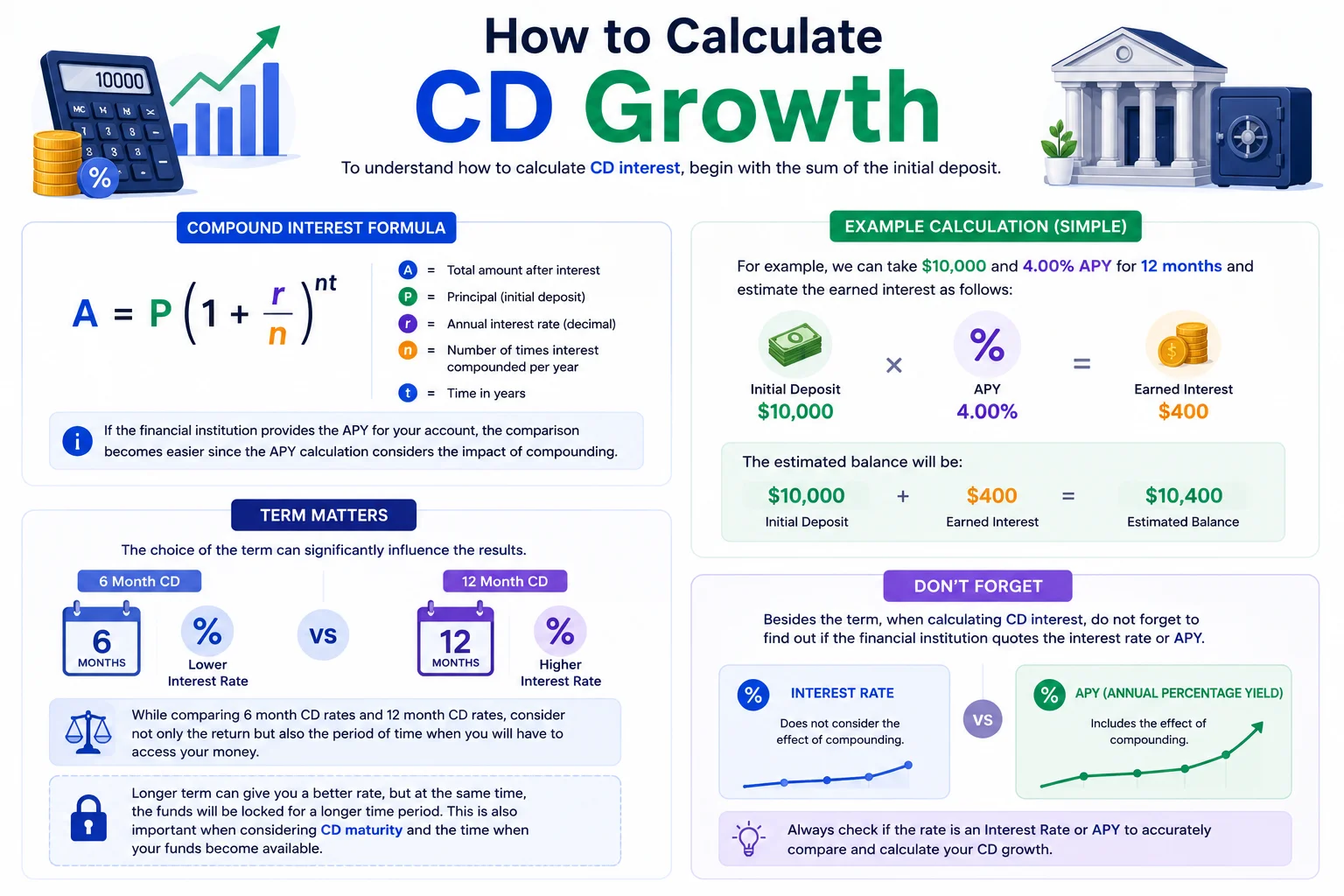
To understand how to calculate CD interest, begin with the sum of the initial deposit.
Compound interest is calculated using the formula:
A = P(1 + r/n)^(nt)
If the financial institution provides the APY for your account, the comparison becomes easier since the APY calculation considers the impact of compounding.
As an easy calculation, for example, we can take $10,000 and 4.00% APY for 12 months and estimate the earned interest as follows:
$10,000 × 0.04 = $400
The estimated balance will be:
$10,000 + $400 = $10,400
The choice of the term can significantly influence the results. While comparing 6 month CD rates and 12 month CD rates, consider not only the return but also the period of time when you will have to access your money. Longer term can give you a better rate, but at the same time, the funds will be locked for a longer time period. This is also important when considering CD maturity and the time when your funds become available.
There is no uniformity in CD rates offered by different financial institutions. They may also differ depending on the length of the CD account. For instance, you may receive various proposals on the rates of six months, 12 months, two years, or even other periods. Certificate of deposit rates can also vary between banks and credit unions, so it is useful to check the terms of each account.
When you compare certificate of deposit interest rates, consider comparable CD terms and the Annual Percentage Yield (APY). At times, it is equally important to pay attention to the minimum deposit, early withdrawal penalty, and maturity conditions.
Thus, 6-month CD rates will work out for those who do not prefer committing their funds for long term. On the other hand, 12 month CD rates may be more favorable for those who have funds available to remain idle for a year. When researching one year CD rates, compare multiple institutions to know how their APYs and account terms vary.
When comparing current CD rates today, make sure to get a good rate by confirming it from the bank offering such accounts. Average CD rates can provide a useful reference when evaluating whether an offer is competitive, while best CD rates may vary depending on the term, deposit amount, and account requirements. Competitive CD rates can also change as market conditions change.
At the same time, these figures cannot say anything about the competitiveness of a specific proposal offered since rates may change due to fluctuations of market conditions and will largely depend on the selected period and deposit amount.
But then, what is considered a good CD rate? This varies depending on individual situations. A good CD rate is one that earns you returns but does not exceed the duration that you are willing to have the cash in the bank.
When comparing CD rates today, make sure to get a good rate by confirming it from the bank offering such accounts.
Using a CD calculator will be helpful here as this will help to bring everything into perspective after you have selected a few banks to work with.
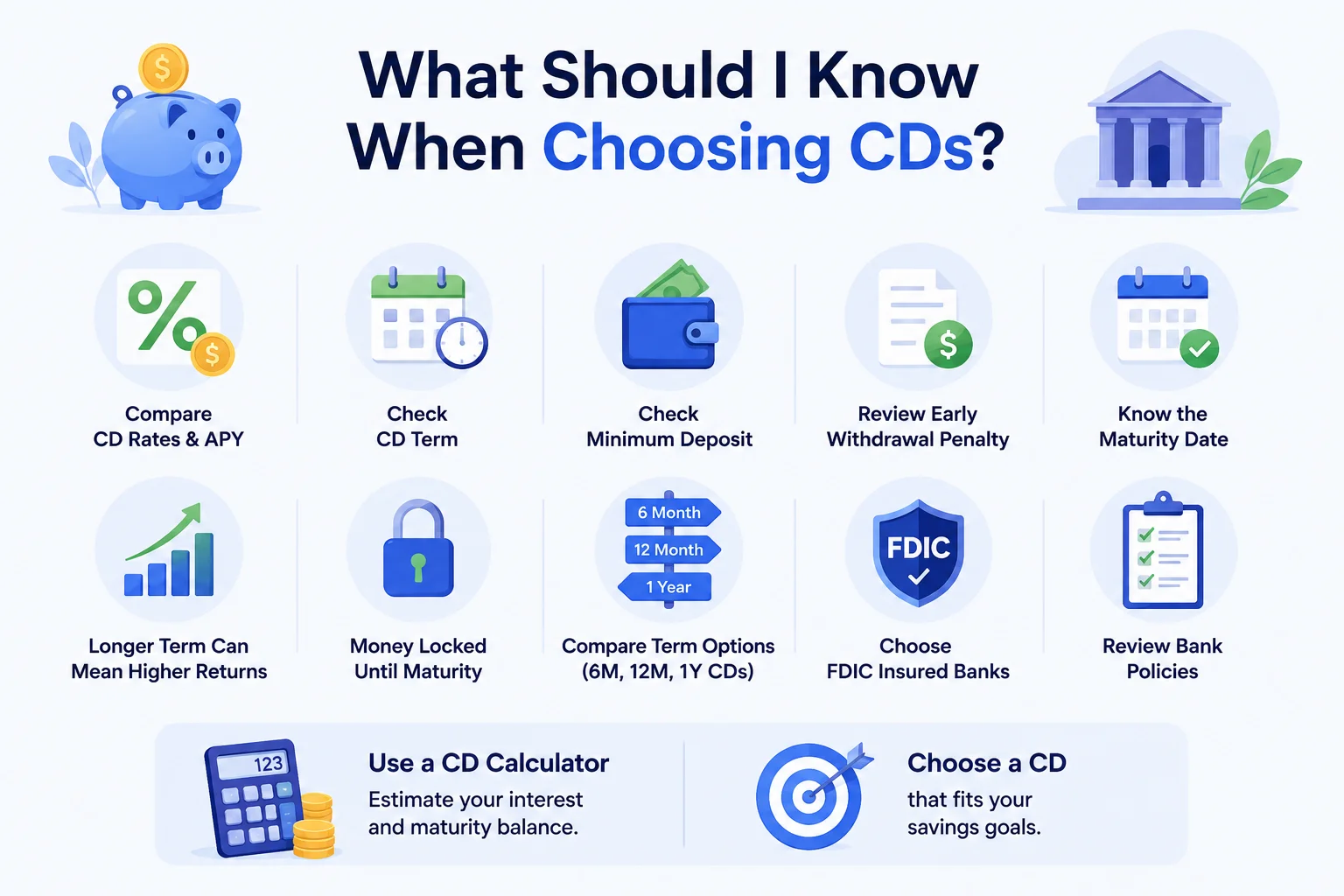
When comparing CDs, don’t just look at the advertized rate. Check the CD interest rates, APY, CD term, minimum deposit, early withdrawal penalty and maturity date to find an account to fit your savings goals. CD rates vary greatly from bank or credit union to bank or credit union, so it pays to shop around and get the best return. A CD calculator can also help you estimate how much interest you might earn and what your maturity balance will be before you invest your money.
When choosing a term, make sure to consider when you expect to need the money. While a longer CD term can lead to higher interest percentage, it might restrict you from withdrawing before the term ends. Just because the term is longer, it does not mean that you will always have high CD rates so make sure to check the various options like a 6 month CD rates, 12 month CD rates, and 1 year CD rates. It’s also necessary to ensure that the bank is FDIC insured and to go over all its policies on how the account functions.
It takes little effort to use the CD calculator. You just have to tell us how much you’d like to put in a CD to begin with. This is the amount of money you will leave in the CD for the time period you and the bank agree to. Then, enter the term of the CD and if you want the time in months or years. Finally, enter the APY (Annual Percentage Yield) and the calculator will display your estimated earnings and value at maturity. You can enter different interest rates such as the 6 month CD rates, 12 month CD rates etc. to see which one gives you the best returns.
CD terms may be listed in either months or years, so use the following conversions when entering your information into a CD rate calculator or certificate of deposit calculator:
| CD Term | Equivalent in Years |
|---|---|
| 6 months | 0.5 year |
| 12 months | 1 year |
| 18 months | 1.5 years |
| 30 months | 2.5 years |
| 48 months | 4 years |
| 60 months | 5 years |
| 84 months | 7 years |
| 120 months | 10 years |
Enter your deposit, term and APY and the CD interest calculator estimates how much interest you might earn and what your account could be worth at maturity. Utilize these results to compute CD interest, compare certificate of deposit interest rates, and review various CD selections based on potential returns and term length.
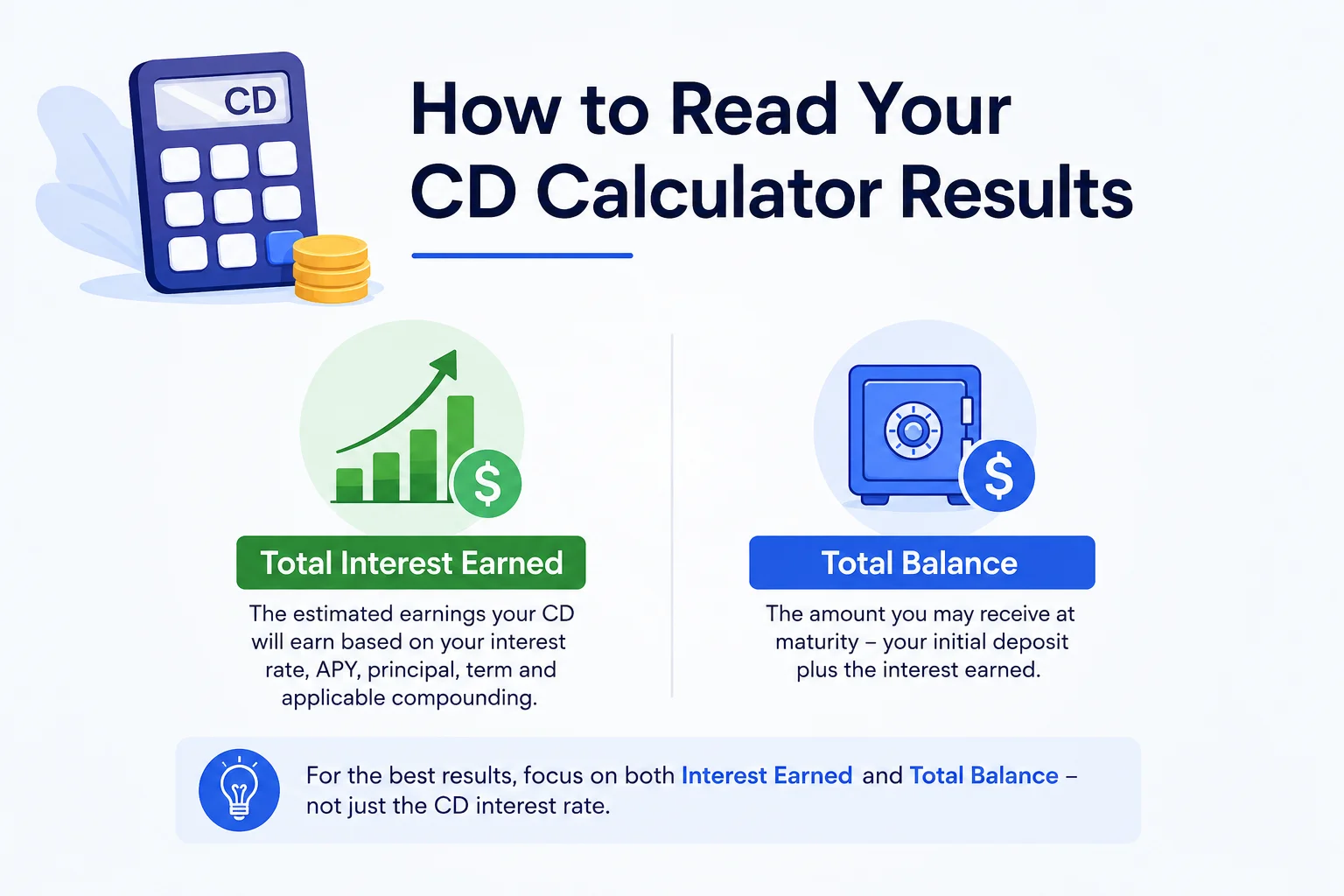
When you input your initial deposit, APY and CD term into the CD calculator, you will see the results of how much your certificate of deposit may earn and how much it may be worth at the maturity date. Total Interest Earned is the estimated earnings your CD will earn based on the interest rate, APY, principal, term and applicable compounding. This is why a CD interest calculator can be useful, whether you want to calculate CD interest or compare different CD rates, such as 6 month CD rates, 12 month CD rates and one year CD rates.
You should think of total balance as an amount that you may receive at the maturity date. In simpler terms, the total balance shows how much your certificate of deposit is worth after both your initial deposit and the interest accrued during the CD period. To get full advantage of the certificate of deposit calculator, make sure that you focus on both interest earned and total balance together rather than looking for only CD interest rates provided.
The CD calculator is designed to estimate returns for conventional CDs offered by banks and certificates of deposit from credit unions. It assumes that the interest earned on your CD stays in the account and continues to grow throughout the CD term. Your estimated earnings are based on the initial deposit, APY, CD term, and the effect of compounding.
The calculator does not account for brokered CDs or other financial products that use different interest-crediting methods, so actual returns may differ from the estimated results. The calculator also assumes that you keep your money in the certificate of deposit until the maturity date. If you withdraw funds before maturity, you may incur an early withdrawal penalty and lose some of the interest you would otherwise have earned.
If you choose to receive regular interest payments instead of leaving the earnings in the CD, your balance may grow differently because the interest is no longer compounding within the account. For these reasons, the calculator results should be treated as estimates when comparing different CD terms, CD rates, APYs, and potential maturity values.
You can buy a CD at banks, credit unions, and sometimes from brokerage companies. It is important to compare APY, maturity term, minimum deposit, compounding frequency, and early withdrawal penalties before opening an account, as interest rates and account terms may differ among banks and credit unions. If you are looking at 6 month, 12 month, or one year CD rates, you can use a CD calculator to estimate how much interest you could earn. Always make sure the bank is insured by the FDIC or the credit union has applicable federal deposit insurance.
Buying a certificate of deposit involves choosing the account type, depositing the required funds, and agreeing to keep the money in the account for the specified term. Banks use customer deposits for various banking activities and pay interest according to the terms of the CD. Before opening an account, review the maturity date, interest rate, withdrawal rules, and other account conditions carefully.
In addition to banks and credit unions, brokerage services may offer certificates of deposit, but some brokered CDs can work differently or have additional fees. For this reason, read the account terms carefully before investing. When looking for the best certificate of deposit rates, pay attention to the APY and consider the overall conditions of the account rather than choosing based only on the advertised interest rate.
The Credit Card Payoff Calculator to understand your credit-related figures.
The strategy of CD laddering involves the process of dividing total savings amongst different CD accounts with varying maturity dates. For example, an individual may decide to divide the total savings into three separate CDs that will have one, two and three-year terms as opposed to tying up all savings in a single CD with a three-year commitment. The money and interest earned from the CD will become available to the individual once each account reaches its term.
CD laddering can give a good balance of liquidity to potential returns, especially if you don’t want to lock away all your money at once. When a CD matures, you have the option of taking the money out and using it for a different financial purpose or reinvesting it back into a new CD that matches whatever the current CD rates are at that moment.
You can also create a ladder using a mix of different terms, including six month CD rates, twelve month CD rates, and one year CD rates according to your needs. This method can be especially beneficial when the interest rates around you change because you are only locking away a part of your money at any given time.
In Europe, centuries ago, banks accepted deposits from customers and lent out these funds, leading to the establishment of a modern certificate of deposit (CD) concept. Initially, banks did not offer any returns when depositing customers’ money. Later, banks began adding a percentage of earnings and paying for how long the money would stay deposited. In the United States, the endorsement of federal deposit insurance by FDIC in the 1930s resulted in a new milestone for deposit products.
Additionally, this legislation allowed the customers to deposit their money with insured institutions with a degree of security. In modern times, banks and credit unions provide certificates of deposit with pre-agreed conditions of maturity, interest rate, and term.
Over the years, CD rates have fluctuated due to changes in the economic environment including monetary policy and inflation. For example, periods characterized by high inflation and interest rates have led to higher CD interest rates than those in periods with lower rates. The Federal Reserve plays a major role in determining the overall interest rate environment, and thus changes in the federal funds rate affect what rates banks pay on various saving products, including 6-month CD rates, 12-month CD rates, and 1-year CD rates.
Therefore, it makes sense to compare the current CD rates and make sure to be aware of the overall interest-rate environment before getting a CD.
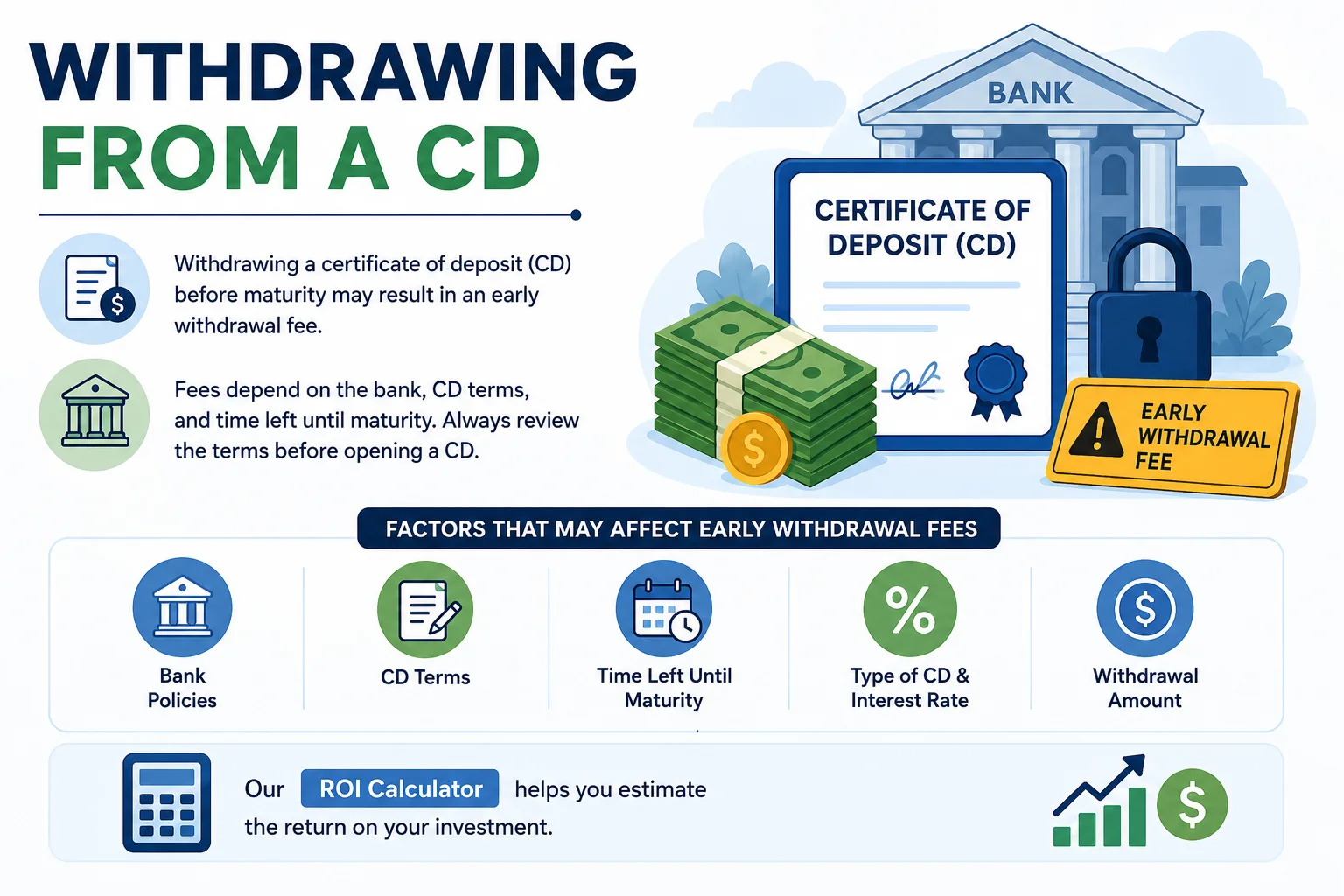
A certificate of deposit (CD) has money that is meant to stay in for the time until the end of the term. If the deposit is withdrawn before maturity, it can lead to an early removal fee imposed by the bank.
These are determined by the institution that holds the CD, terms of the deposit, the amount left till the maturity date, etc. Before you get a CD, check carefully the terms of withdrawal and think about the chances you may wish to have access to your deposit before the end of maturity.
Our ROI Calculator helps you estimate the return generated from an investment by comparing your initial investment with the final value or profit.
If you want something other than Certificates of Deposit, there are a few things you can consider. These things might give you flexibility or a better return depending on what you want to do with your money and how much risk you are willing to take.
One thing you can do is pay off debt. This is an idea if you have credit cards or loans with high interest rates. When you pay off debt, you know how much money you are saving because you are not paying all that interest.
You can also put your money in a money market account. This is an option if you want to be able to get your money easily and you do not want to take a lot of risk. Money market accounts are usually offered by banks. They often have good interest rates. They also have insurance so you do not have to worry about losing your money.
Bonds are another thing you can consider. There are kinds of bonds like government bonds, municipal bonds, and corporate bonds. These bonds can give you income, but they are not all the same. Some bonds are riskier than others. Some take longer to mature. Certificates of Deposit and bonds are not the thing, so you have to think about what you want when you are deciding which one to choose.
Paying off debt and putting money in a money market account or bonds can be alternatives to Certificates of Deposit. You just have to think about what you want to do with your money and how much risk you are willing to take.
You can also use the Compound Interest Calculator to see how your money can grow over time through compounding.